The post Loose cushions, overhang, shape and filling appeared first on FLEMING HOWLAND.
]]>With time and use the shape of the cushions will change and adapt to your size and weight. Leather is a natural material and will stretch/contract constantly often resulting in leather ripples on the cushion surface. The filling will also move around inside the casing (especially duck feather). We do not recommend over-stuffing the cushions as they are pre-filled to an optimum level.
The post Loose cushions, overhang, shape and filling appeared first on FLEMING HOWLAND.
]]>The post Handmade Furniture Dimensions and Tolerances appeared first on FLEMING HOWLAND.
]]>This is normal within handmade upholstery. Each frame, cushion, padding layer and upholstered surface is formed and finished by hand, not produced to machine-line tolerance.
Dimensional tolerance
A dimensional tolerance of approximately 6cm / 2.36in in each dimension may be expected, depending on the design, size and construction of the piece.
This tolerance may apply to:
- Overall height
- Overall width
- Overall depth
- Seat height
- Seat width
- Seat depth
The final measurement can be affected by frame construction, upholstery depth, cushion fill, padding compression, buttoning, seam position, leather or fabric tension, and the natural settlement of upholstered materials.
Published dimensions
Published dimensions are provided as a guide to scale and proportion. They should not be treated as exact finished measurements. For handmade upholstered furniture, small dimensional differences do not indicate a manufacturing fault. They reflect the nature of hand-built frames, hand-applied upholstery and material behaviour under tension.
Bespoke dimensions
Where bespoke dimensions are requested, the final piece may still require small technical adjustments to preserve proportion, comfort and construction integrity.
This may affect:
- Seat and back relationship
- Cushion layout
- Buttoning position
- Arm proportion
- Frame balance
- Upholstery tension
- Overall silhouette
A requested dimension must work with the structure of the design. In some cases, the final proportion is adjusted to ensure the piece remains stable, comfortable and visually resolved.
How to measure your furniture
Use a rigid tape measure and place the furniture on a level floor. For outside dimensions be sure to push the arm or back up against a vertical reference point such as a wall or flat object. Do not compress cushions, arms, padding or upholstery while measuring. Measure from the outermost or highest finished points unless stated otherwise.
Expected tolerance can be approximately 6cm (2.36 inches) as illustrated with the orange shaded areas in below images.
Overall height
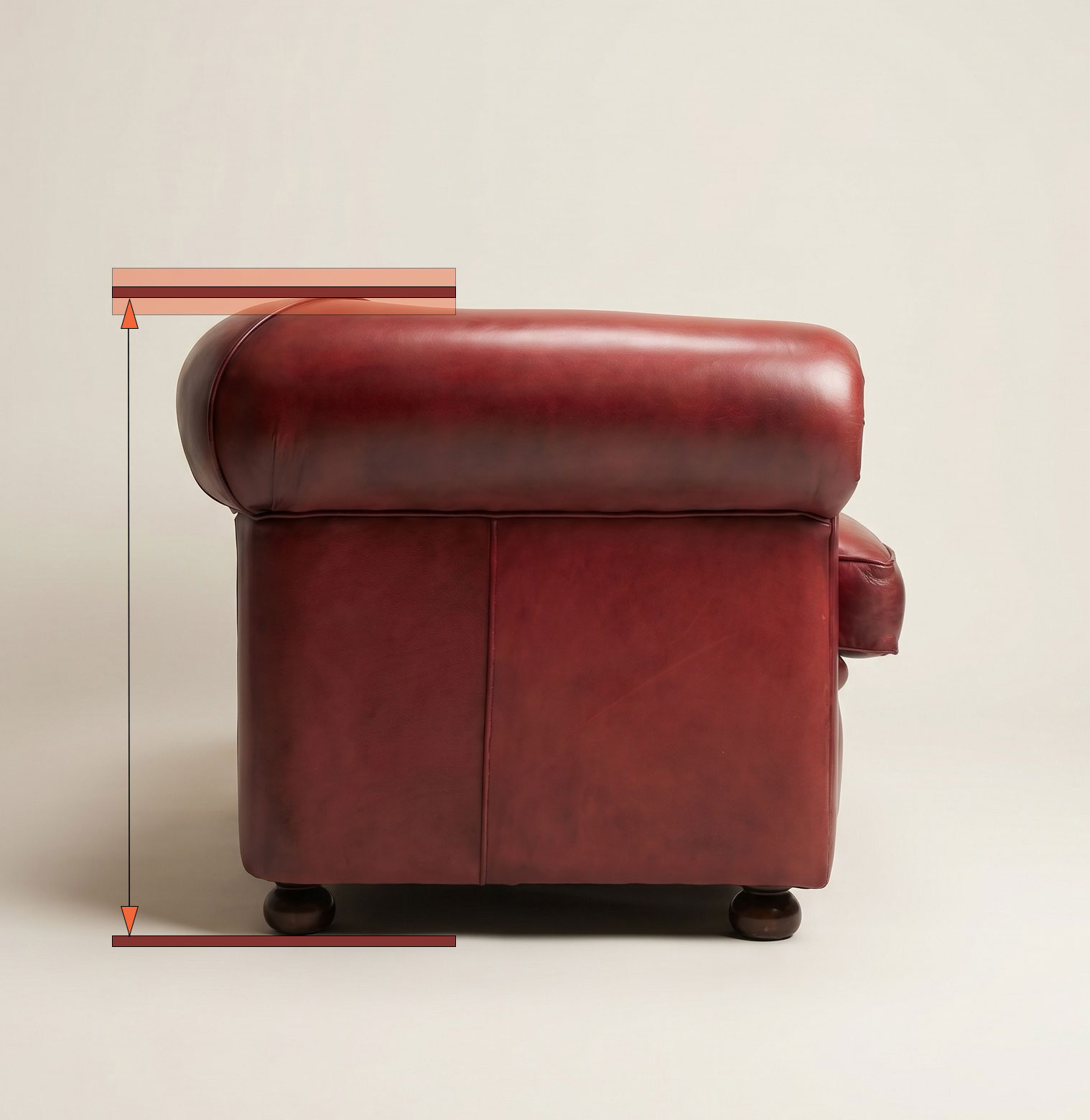
Measure from the floor to the highest point of the furniture. This is usually the top of the back, crest rail or highest upholstered section. Use a flat object such as a large book to balance on the top surface, highest point. Do not measure only to the seat or cushion unless you are checking seat height.
Overall width
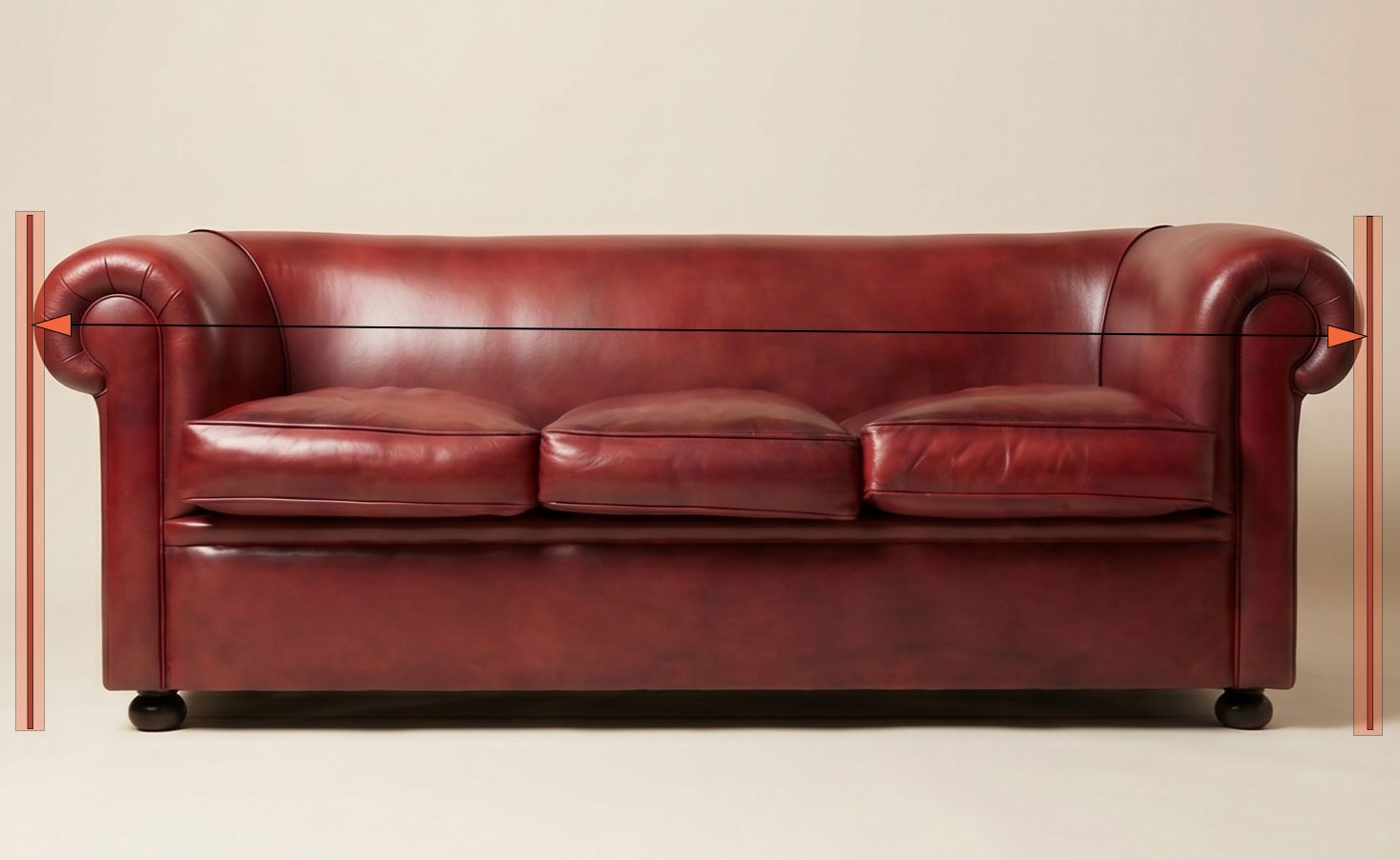
Measure across the widest external point of the furniture. For sofas and chairs, this is normally from the outside edge of one arm to the outside edge of the opposite arm. Include the full upholstered form, not only the internal sitting area.
Overall depth
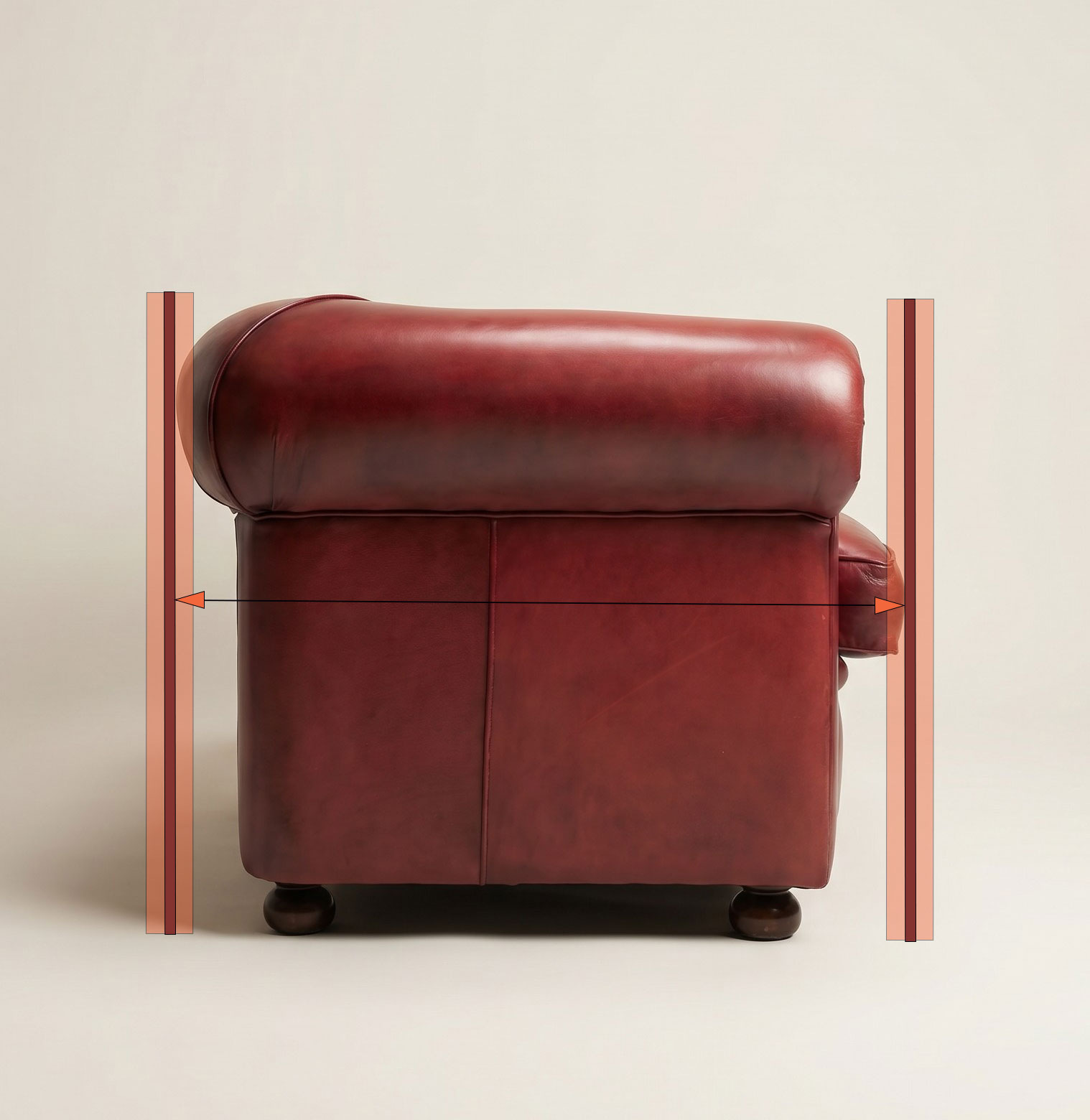
Measure from the most forward point to the furthest rear point. This usually means from the front edge of the frame, arm or cushion to the back of the furniture. Overall depth is not the same as seat depth.
Seat height
Measure from the floor to the top of the seat surface. For loose seat cushions, measure to the natural top surface of the cushion without pressing down. Cushion fill may sit slightly proud when new and settle with use.
Seat width
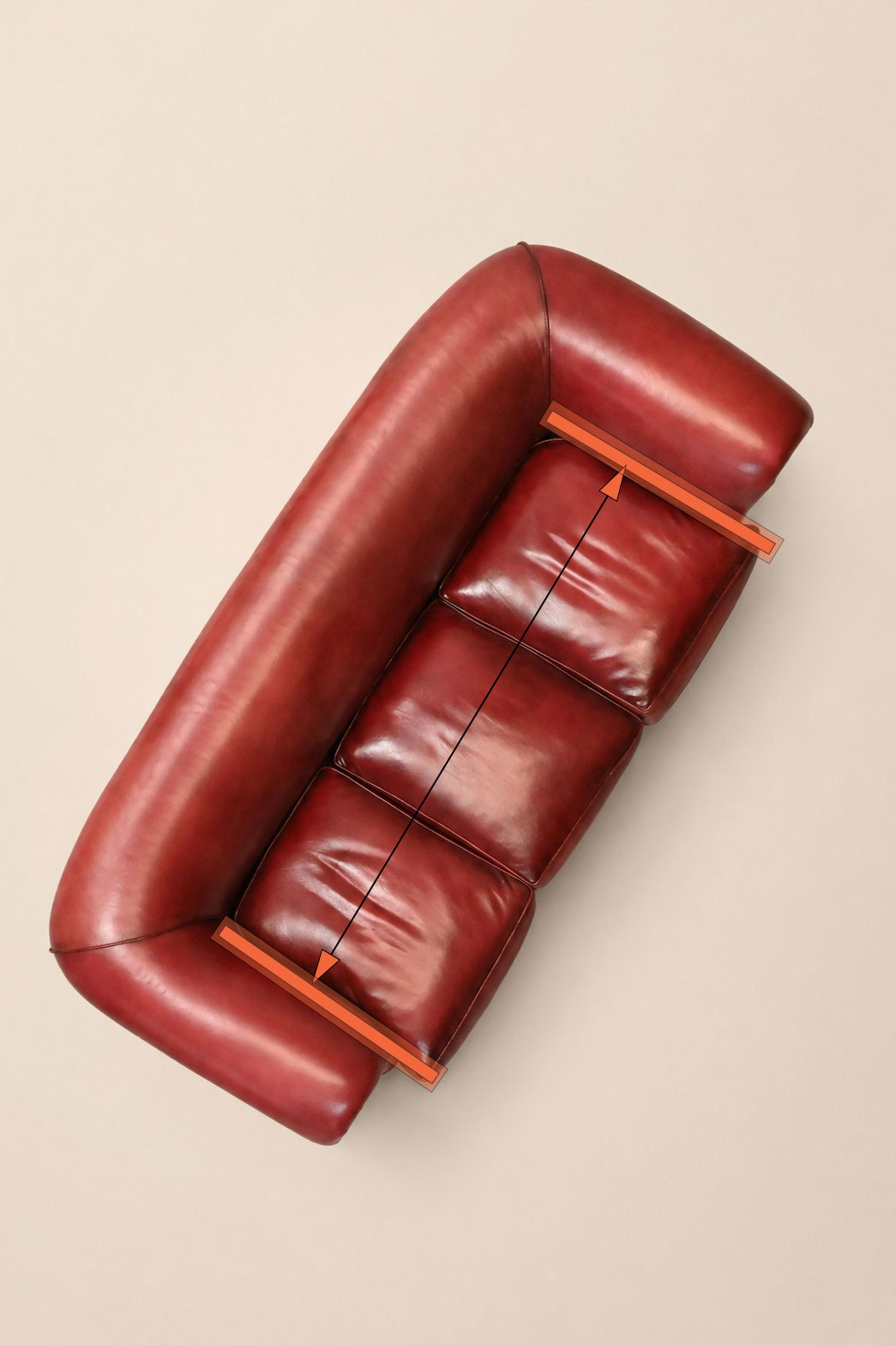
Measure the usable sitting width. For sofas and armchairs, this is normally the internal distance between the arms. Where the piece has no arms, measure the upholstered seat area intended for sitting.
Seat depth
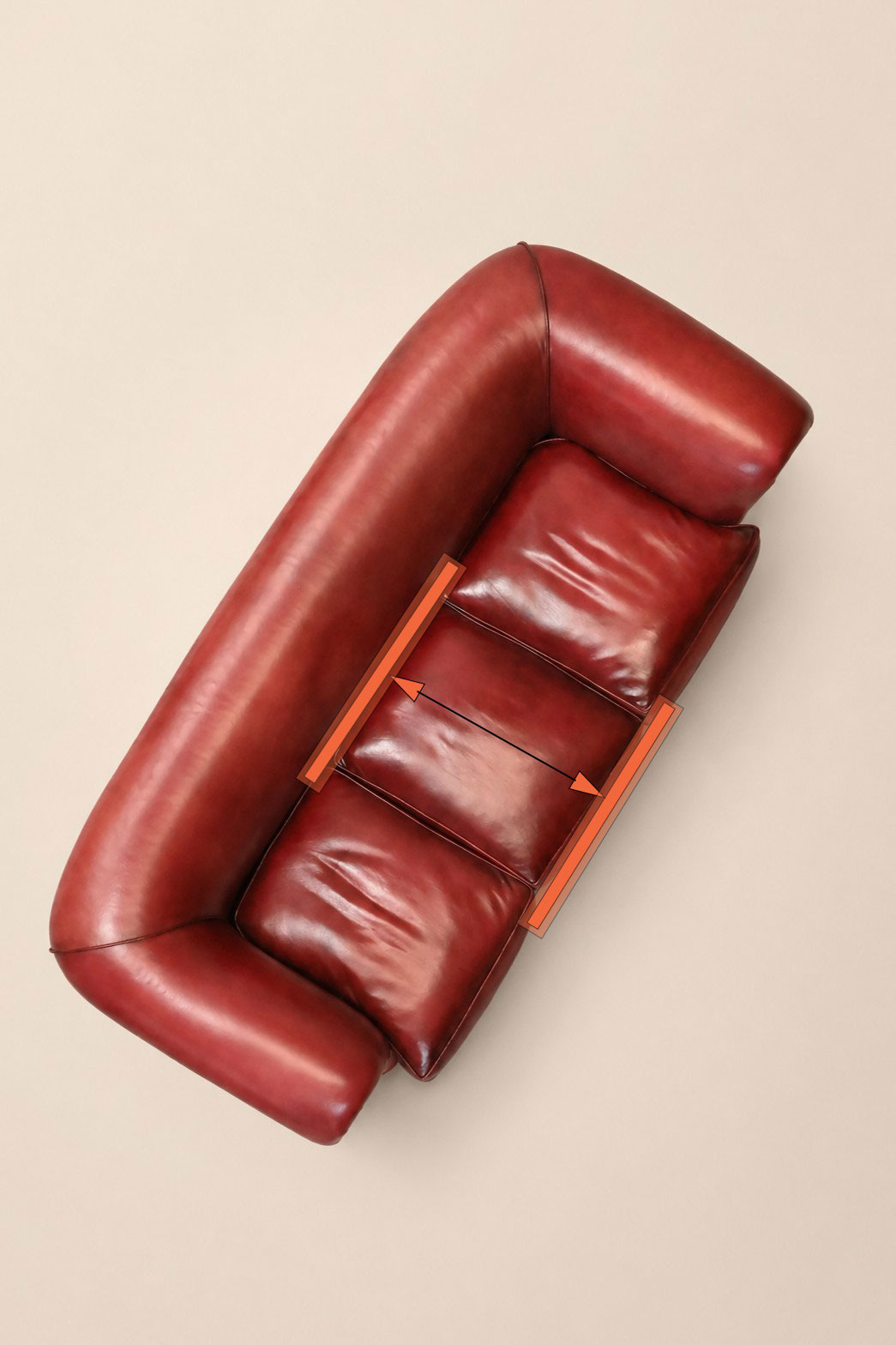
Measure the usable sitting depth. This is taken from the front edge of the seat to the point where the seat meets the back cushion or back upholstery. It should not be taken to the rear outside edge of the furniture.
Access-critical measurements
If a dimension is critical for access, installation or a fixed interior layout, it should be raised before ordering.
This includes doorways, staircases, lifts, corridors, alcoves, built-in joinery and tight room plans. Fleming Howland can review the relevant constraints before production or delivery, but finished handmade dimensions may still remain subject to the stated tolerance unless otherwise confirmed in writing.
Measurement differences after delivery
When checking a finished piece, use the same measurement points shown in the technical drawing above. Differences can occur when measurements are taken from different positions, from softened upholstery edges, or from cushion surfaces that naturally crown, compress or settle.
Where a measurement appears different from the published specification, Fleming Howland will assess the piece against the relevant product dimensions, approved order details and handmade tolerance.
The post Handmade Furniture Dimensions and Tolerances appeared first on FLEMING HOWLAND.
]]>The post Decorative nails (studs) appeared first on FLEMING HOWLAND.
]]>Our recommendations are based on the tone and character of each material collection.
Heirloom collection Hand-Coloured leathers
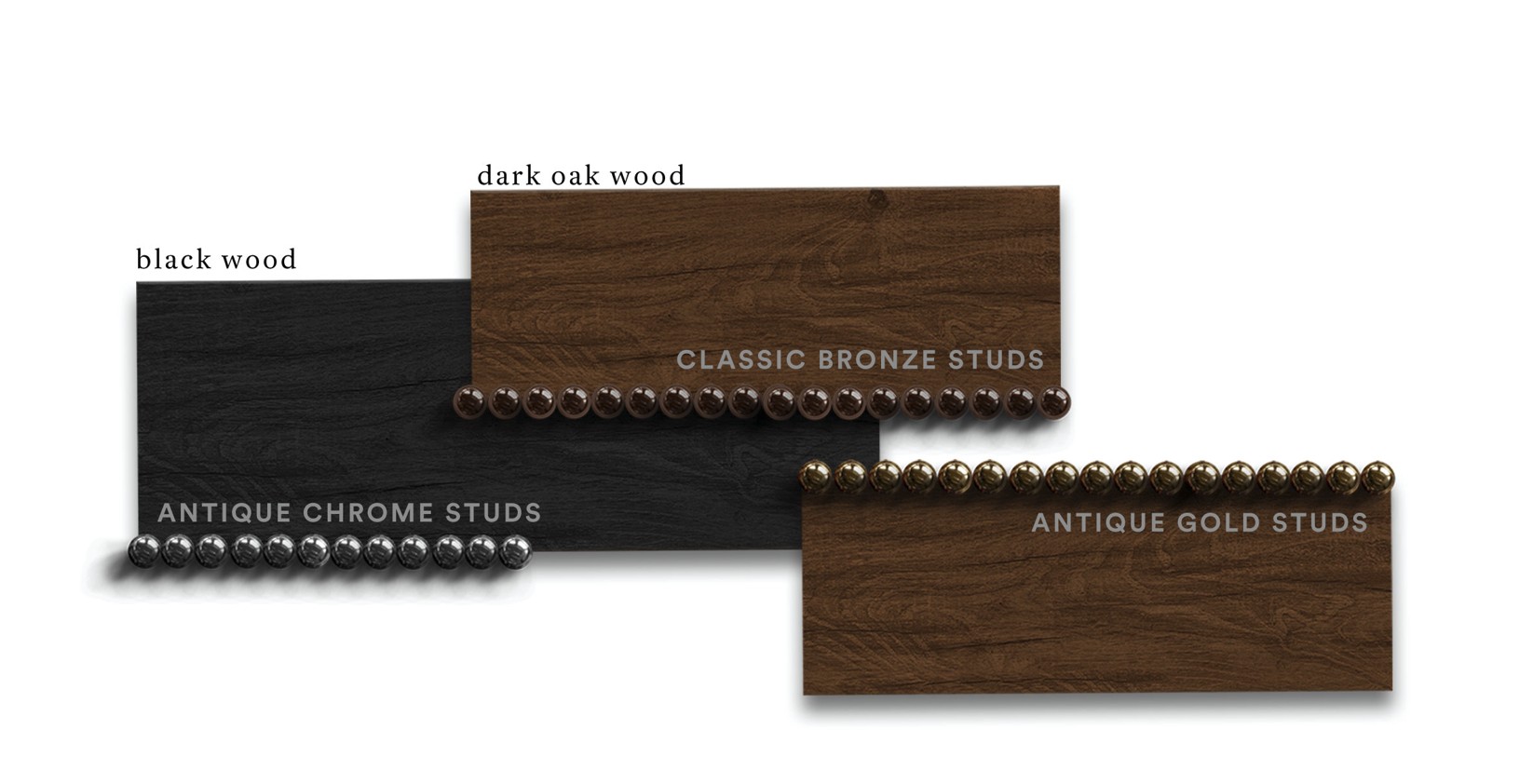
For leathers within the Heirloom collection, we recommend Antique Gold decorative nails with a Dark Oak wood finish.
This combination works well with the depth, warmth, and natural variation of Heirloom leathers. Antique Gold adds a softened metallic detail without appearing too bright, while Dark Oak gives the base a grounded, traditional finish.
Monochrome collection Hand-Coloured leathers
For leathers within the Monochrome collection, we recommend Antique Chrome studs with a Black wood finish.
This pairing keeps the overall look clean and tonal. Antique Chrome complements cooler leather shades, while Black wood maintains a sharper, more contemporary outline.
Antiqued and Saddle leathers
For Antiqued or Saddle leathers, we recommend Classic Bronze studs with a Dark Oak wood finish.
Classic Bronze has a warmer, aged tone that sits naturally with leathers that already carry depth, patina, or a more traditional character. Dark Oak supports this finish without creating too much contrast.
Wools, velvets, and other fabric upholstery
For fabrics such as wool, mohair, and velvet, we generally recommend no decorative studs as shown in these examples.
Fabric upholstery often benefits from a cleaner finish, allowing the texture, silhouette, and tailoring of the piece to remain the focus. Omitting studs can create a more restrained and contemporary appearance, particularly on softer or more design-led pieces.
Choosing a different stud finish
These are our recommended combinations, but you can choose a different stud or wood finish if you prefer.
Some clients may want a stronger contrast, a more traditional look, or a finish that better suits an existing interior scheme. If you are unsure, our team can advise on the most suitable combination for your chosen upholstery.
Choosing the Right Finish
When selecting decorative nails, consider:
- The colour and tone of the upholstery
- Whether the piece should feel traditional, contemporary, or understated
- The wood finish on the legs or frame
- Other metal finishes in the room
- Whether the studs should be visible as a feature or sit quietly within the design
For most pieces, we recommend keeping the combination balanced: warm leathers with warmer metals, cooler leathers with cooler metals, and fabrics with little or no metal detailing.
To request samples of the decorative nails or for any further advice please contact us.
The post Decorative nails (studs) appeared first on FLEMING HOWLAND.
]]>The post Customising an ottoman appeared first on FLEMING HOWLAND.
]]>
Why proportion matters
An ottoman that is too small can feel insubstantial and visually disconnected from the chair. One that is too large risks dominating the composition or lifting the legs into an uncomfortable position.
By sizing the ottoman relative to the chair, three things are achieved:
Ergonomic comfort
The legs extend naturally without pressure behind the knees
Visual harmony
The ottoman appears intentionally paired with the chair
Balanced scale
The chair remains the principal piece in the arrangement
The ideal proportions
For most lounge and club chairs, the following ratios produce the most comfortable and aesthetically balanced result.
Height
The ottoman should sit slightly below the chair’s compressed seat height. Recommended proportion is approximately 85% below the seat height. This allows the legs to extend naturally while maintaining a relaxed posture.
Width
The width of the ottoman is best calculated from the usable seat width between the chair arms. Recommended proportion is 90% of seat width. This provides generous support for the feet while ensuring the ottoman remains visually subordinate to the chair.
Depth
Depth should allow the calves to rest comfortably without forcing the sitter too far back into the chair. Recommended proportion is 80% of seat depth. This creates a natural lounge position without restricting movement.
Pairing a footstool or pouffe
In a similar fashion when pairing a footstool or pouffe with a sofa or chair, we usually recommend setting it quite a bit lower than the stated seat height. Seat height is measured uncompressed, and once seated the cushion will settle. As a practical guide, a comfortable footstool height is often around 65% of the nominal seat height, depending on cushion type and firmness. We will confirm the best proportion once we know the sofa or chair model and your preferred type of seating. If you can confirm the sofa or chair you are pairing it with, whether you plan to use a coffee table alongside it, and how frequently you expect to use it for feet-up comfort, we can recommend a size and height that sits correctly both visually and ergonomically.
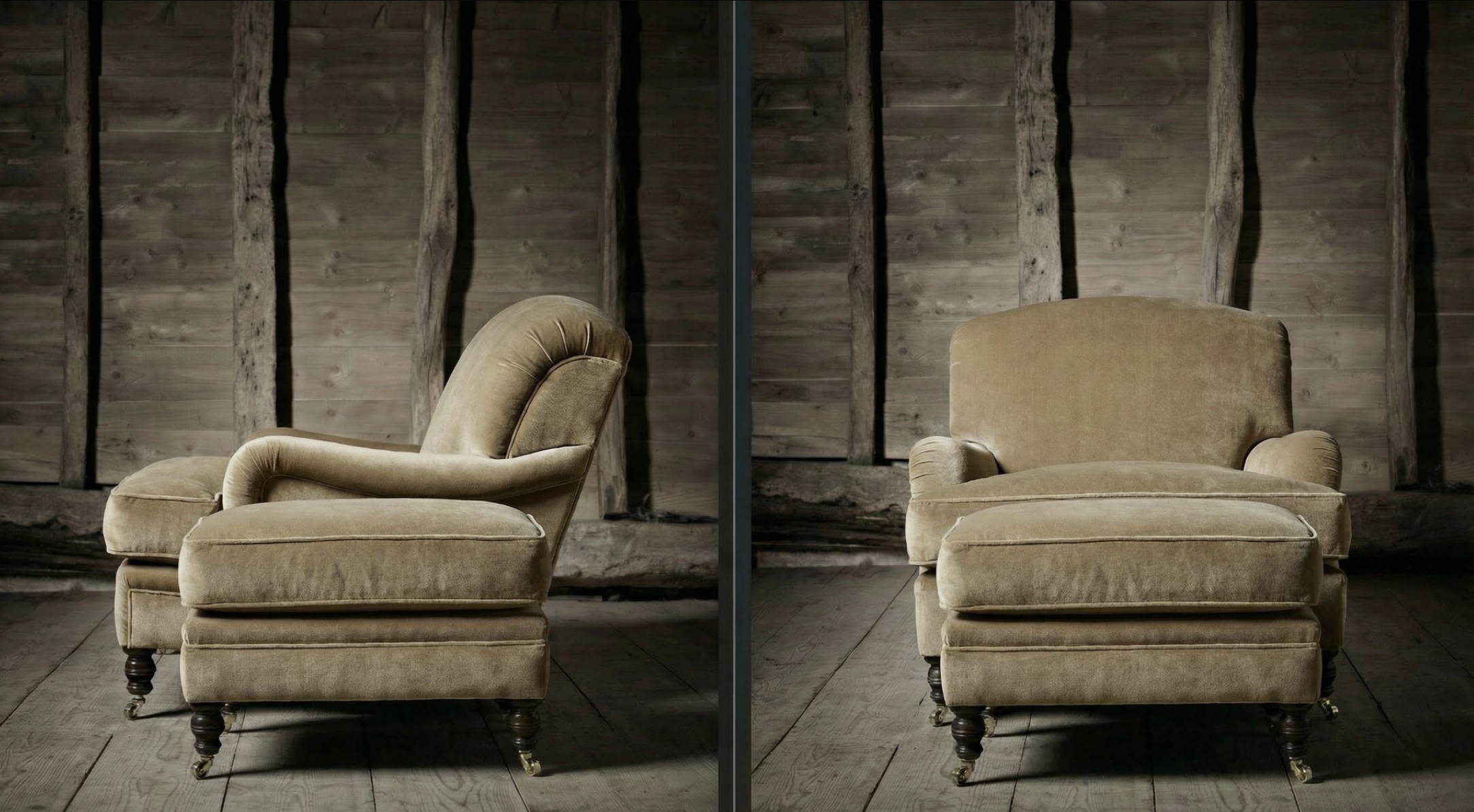
Because every Fleming Howland is individually crafted, the accompanying ottoman or foot rest is ideally sized to match the piece it serves. Using proportional measurements ensures the foot rest feels neither generic nor oversized.
The post Customising an ottoman appeared first on FLEMING HOWLAND.
]]>The post Weight bearing and structural integrity appeared first on FLEMING HOWLAND.
]]>Internal frames are typically constructed from solid beech timber and/or multi-directional hardwood plywood, materials widely recognised for their structural integrity, load distribution, and resistance to fatigue over time. Joinery, fixing methods, and upholstery build-ups are specified to work as a complete structural system, ensuring the furniture remains supportive, stable, and dependable through many years of regular use.
The post Weight bearing and structural integrity appeared first on FLEMING HOWLAND.
]]>The post Upholstery spring systems appeared first on FLEMING HOWLAND.
]]>Steel serpentine (Zig-Zag) springs
A continuous high-tensile steel wire fixed across the seat frame. This system offers consistent tension, strong resilience under repeated load, and simple future replacement. It works harmoniously with modern foam and fibre layers and is widely used across premium British and European upholstery.
Fish-Mouth coil springs
Factory-calibrated open coils mounted to a steel frame, offering deep vertical travel and long-term shape retention. These units absorb shock effectively, maintain seat height over many years, and can be replaced cleanly during restoration.
Elastic Webbing
Elastic webbing is used selectively within Fleming Howland’s smaller pieces, typically items where the frame geometry does not allow for steel serpentine or coil springs. High-tension webbing provides stable lateral support without adding unnecessary height or weight. When applied correctly, it offers reliable elasticity, quiet operation and long-term resilience. Its purpose within Fleming Howland’s construction is practical rather than cost-driven: a measured solution for small formats where engineered steel systems cannot physically be installed.
Why Fleming Howland Does Not Use Eight-Way Hand-Tied Springs
Eight-way hand-tied (EWHT) springs remain familiar in the United States, yet the system is now considered outdated across the UK and Europe. Its performance depends entirely on manual tying, which creates inconsistencies, complex maintenance, and long-term fragility due to natural fibres. Very few modern upholsterers are trained to repair it, making lifetime serviceability increasingly impractical. For these reasons, Fleming Howland does not implement EWHT. Instead, the seating architecture relies on engineered spring systems that deliver predictable comfort, durable support, and straightforward servicing decades after purchase.
The post Upholstery spring systems appeared first on FLEMING HOWLAND.
]]>The post Interior Design Service appeared first on FLEMING HOWLAND.
]]>The post Interior Design Service appeared first on FLEMING HOWLAND.
]]>The post Furniture covers appeared first on FLEMING HOWLAND.
]]>Each piece is defined by its silhouette: the cadence of the buttoning, the curve of the arm, the play of light across leather or velvet. A cover would obscure these qualities, adding bulk and diminishing the very proportions that make the design enduring. Beyond aesthetics, our materials are chosen to breathe and to age with grace. A cover can trap moisture and restrict this natural process, ultimately shortening the life of the upholstery.
Our furniture is intended to be enjoyed as it is. For protection, we guide clients instead towards considered care and maintenance, ensuring the piece matures beautifully in use.
The post Furniture covers appeared first on FLEMING HOWLAND.
]]>The post Technical sheets and information appeared first on FLEMING HOWLAND.
]]>As every piece is handmade to order, alterations to size, specification, design and upholstery are possible. Customers may select from the full range of standard finishes, fabrics and leathers for application to any model. Bespoke adjustments to scale and detailing are also available on request.
Technical sheets can be accessed on the product page under the pricing section. Fleming Howland does not issue a printed price list, as prices are dynamic and subject to change. Factors such as shipping costs, taxes, currency exchange rates, and other logistics charges influence the final price of each order. For this reason, customers are advised to always refer to the Fleming Howland website for the most accurate and up-to-date pricing information.
For additional guidance, or to request customised specifications, customers should contact Fleming Howland directly.
The post Technical sheets and information appeared first on FLEMING HOWLAND.
]]>The post Understanding Custom-Made Beds appeared first on FLEMING HOWLAND.
]]>Custom Order Process
Initiation: Customers begin by submitting an enquiry specifying their desired bed dimensions, design, material preferences, and any special features or customisations.
Consultation: The Fleming Howland team reviews the enquiry and may arrange a consultation to discuss available options and confirm specifications.
Order Confirmation: Once all details are agreed, a comprehensive order summary is provided for approval, ensuring every aspect of the bed aligns with the customer’s expectations before production begins.
Production Timeline
Each bed is crafted individually by skilled artisans, so production times vary depending on design complexity and current order volumes. Estimated completion and delivery dates are shared with customers at the order confirmation stage.
Material and Design Options
Fleming Howland offers a wide selection of materials and design choices to suit diverse aesthetic and functional requirements. Guidance is available to help customers select the most suitable options for durability and style.
Delivery and Aftercare
When the bed is complete, the logistics team arranges delivery at a time convenient to the customer. Detailed care instructions are also provided to support the long-term maintenance and preservation of the custom-made bed.
The post Understanding Custom-Made Beds appeared first on FLEMING HOWLAND.
]]>The post Corner Sofas appeared first on FLEMING HOWLAND.
]]>If you’d like a bespoke creation to fit into a specific space, please get in touch with your required dimensions. Curved and perpendicular/right angle corner units are available depending on design choice, along with reverse configurations if required.
The post Corner Sofas appeared first on FLEMING HOWLAND.
]]>The post Recliner furniture and footstools appeared first on FLEMING HOWLAND.
]]>To take a look at the Fleming Howland Footstool range, click here.
The post Recliner furniture and footstools appeared first on FLEMING HOWLAND.
]]>The post Bespoke service appeared first on FLEMING HOWLAND.
]]>Fleming Howland makes every piece of furniture to order, allowing for customisations in size, comfort, decorative detail, and upholstery material. The design team specialises in projects that require furniture with specific dimensions, creating bespoke frames that maintain correct proportions and distinctive, one-of-a-kind pieces. To read more about bespoke furniture options, click here.
The post Bespoke service appeared first on FLEMING HOWLAND.
]]>The post Sofa Beds appeared first on FLEMING HOWLAND.
]]>For further technical details on the bed mechanisms, please follow this link.
The post Sofa Beds appeared first on FLEMING HOWLAND.
]]>The post Reversible Cushions appeared first on FLEMING HOWLAND.
]]>If reversibility is a critical consideration, opting for fabric cushions might be a more suitable choice. As fabric cushions are naturally breathable, Fleming Howland can make them reversible if required. This option is available upon request.
The post Reversible Cushions appeared first on FLEMING HOWLAND.
]]>The post Furniture Safety & Materials Policy appeared first on FLEMING HOWLAND.
]]>Fleming Howland furniture is produced in accordance with the fire safety regulations applicable in the country of delivery. Each item is specified to meet the required standard, ensuring compliance while preserving the integrity of traditional upholstery materials and methods.
International compliance
Fire safety requirements vary significantly by market. In all cases a FR interliner is used to meet EN 1021‑1 / EN 1021‑2 (cigarette & match ignition tests) Upholstery.
United Kingdom
Upholstered furniture must comply with the Furniture and Furnishings (Fire) (Safety) Regulations 1988 (as amended), which require the use of certified fire-retardant fillings, including foam.
Europe, United States and rest of world
Regulations typically rely on smoulder resistance testing rather than open-flame performance. These standards do not require the use of chemically treated foam.
Fleming Howland manufactures each piece to the relevant local standard, with full certification and traceability.
Our construction method: barrier over chemical treatment
Where regulations allow, Fleming Howland adopts a barrier-based approach to fire compliance.
For fabric upholstery:
A specialist interliner (fire barrier fabric) is placed between the outer fabric and the filling.
This prevents ignition from reaching the core materials.
The outer fabric remains untreated, preserving its natural handle, tone and performance.
This method achieves compliance without relying on additional chemical treatment of visible materials.
Use of fire-retardant foam
Fire-retardant (FR) foam is used only where explicitly required by local regulations, such as within the UK.
All foam used in these cases is fully certified to the applicable standard.
Materials are sourced from approved suppliers with complete compliance documentation.
Where regulations do not require FR-treated foam, Fleming Howland specifies non-FR foam in combination with barrier materials, in line with international best practice.
Material composition across our production
As the majority of Fleming Howland furniture is produced for export to markets that do not mandate FR-treated foam, most items are constructed using barrier methods rather than chemical-dependent solutions.
In practice, this means that approximately 90% of Fleming Howland furniture does not use FR chemical treatment, because most of our production is exported to countries where such treatment is not required.
This reflects a consistent internal policy:
Prioritise construction-led fire safety.
Minimise unnecessary chemical treatment where compliant alternatives exist.
Maintain the natural qualities of upholstery materials.
Transparency and traceability
Each piece is supplied with:
Appropriate compliance labelling for its destination market
Full material traceability
Supporting documentation available upon request
Ongoing review
Fire safety standards continue to evolve internationally. Fleming Howland actively monitors regulatory developments and adopts improved methods where they enhance both safety performance and material integrity.
The post Furniture Safety & Materials Policy appeared first on FLEMING HOWLAND.
]]>The post Seat options appeared first on FLEMING HOWLAND.
]]>
Fibre
We recommend fibre for most requirements and this type of filling is the standard option for our Classic collection. Duratech fibre cushions are the only cushion on the market to currently hold the FIRA Gold Award accreditation. Made from a polymer manufactured 100% from recycled polyester bottles, fibre cushions offer the best support with the lowest maintenance as well as a nicely domed surface. Fibre density: 27kg/m3
Duck Feather
The more luxurious feeling duck feather fillings are by far the softest option and so sinking lower into the seat tends to give a little more back support. Feathers, being a natural material, will constantly move around giving a traditional ‘lived in’ look to your furniture. They tend to sag over time, and so require regular plumping. A little more expensive than fibre or foam, this option is standard for the Heirloom, Monochrome and Club collection. Higher maintenance but a very traditional option.
Foam
For fixed pull-over, tufted seating or contract grade loose cushions, our high-density foam option provides a distinctly firmer, more supportive sit while maintaining a crisp, tailored profile. Its excellent recovery properties allow the seat to return to its original shape after use, preserving clean lines with minimal dressing. Foam densities range from 60–90 kg/m³, selected according to the required comfort, structure and application.
Buttoned Seat
The buttoned seat is a fixed seat option being a continuation of the back and arm. It offers a much firmer sit but is deceptively comfortable due to the added support within the upholstery itself. Foam densities range from 60–90 kg/m³.
The post Seat options appeared first on FLEMING HOWLAND.
]]>The post Classic vs. Heirloom appeared first on FLEMING HOWLAND.
]]>The Classic range emanates strong, reliable raw materials combined with traditional British craftsmanship and modern production techniques.
Features include top-grain, pigmented cow hides with an antiqued finish; hand-joined hardwood internal frame (dowelled, glued and screwed); solid beech bun feet stained in dark oak; serpentine steel spring system within the seat; interwoven webbing throughout the seat, back and arms; fibre cushion fillings as standard (optional feather-down); individually hand-nailed bronze studding.
An Heirloom needs to be handcrafted using traditional nineteenth-century techniques. This means more time-consuming methods and greater attention to detail.
Features include full aniline cow hides (hand-sewn, hand-coloured and wax finished); hand-joined hardwood internal frame (dowelled, glued and screwed); solid redwood (sapele or wenge) for visible parts of the frame and legs where applicable; a combination of serpentine steel coil and/or fish mouth spring systems for optimum support throughout seat, back and arms; layered stuffing with hand-sewn muslin pad base; duck down and duck feather seat filling as standard (optional non-allergic fibre); solid brass castors where applicable; individually hand-nailed antique gold studding.
The post Classic vs. Heirloom appeared first on FLEMING HOWLAND.
]]>The post Sustainability appeared first on FLEMING HOWLAND.
]]>Sustainability extends beyond the choice of materials to encompass durability as well. Through their designs, Fleming Howland places a premium on quality, ensuring that their furniture withstands the test of time, thereby reducing the need for frequent replacements. Additional information can be found in the ‘Built For Future Generations’ article available here.
The post Sustainability appeared first on FLEMING HOWLAND.
]]>The post Bespoke bar stools and counter top height appeared first on FLEMING HOWLAND.
]]>A good rule of thumb is to choose a stool that is about 10-12 inches shorter than the height of your bar or counter. For example, if your bar or counter is 42 inches tall, you should look for a stool that is around 30-32 inches tall.
It’s also important to consider the style and design of the stool, as well as the materials and quality. You want a stool that is comfortable and durable, and that fits in with the overall decor of your space.
Fleming Howland provides personalized dimensions for their complete furniture selection, encompassing bar stools. This capability enables the creation of stools precisely suited to the height of customers’ bars or counters, aligning seamlessly with their individual design and style inclinations. In instances where individuals encounter difficulty in identifying the ideal stool, they are invited to communicate and explore the bespoke alternatives. Meanwhile, additional details regarding the bar stool collection can be located here.
The post Bespoke bar stools and counter top height appeared first on FLEMING HOWLAND.
]]>